
The Countdown is On! Only 38 Days Until Carnival!
Carnival fever is already taking over Rio de Janeiro! With just 38 days until the greatest folk festival on the planet, technical rehearsals are in full swing, costumes are being meticulously crafted, and the city is preparing to welcome millions of revelers.
While the excitement builds, let’s take a look back at history to understand how this grandeur was born. How did simple street celebrations transform into the epic parades we witness today at the Marquês de Sapucaí?
The history of Rio’s Carnival is a rich tapestry, woven with European, African, and Indigenous influences that have evolved over centuries.
European Roots: Entrudo and Masquerades

The first carnival manifestations in Brazil arrived in the 17th century from Portugal with the Entrudo. It was a popular and often chaotic festival where people threw water, flour, and even eggs at one another. While it was a fun mess, it was eventually banned by authorities for being “disorderly.”
Over time, the Brazilian elite—inspired by the carnivals of Paris and Venice—began organizing “civilized” masked balls and costume parades called Grandes Sociedades (Great Societies). These featured luxury floats and elaborate costumes that paraded through the city’s wealthier areas.
The Power of Afro-Brazilian Culture: Cordões and Ranchos
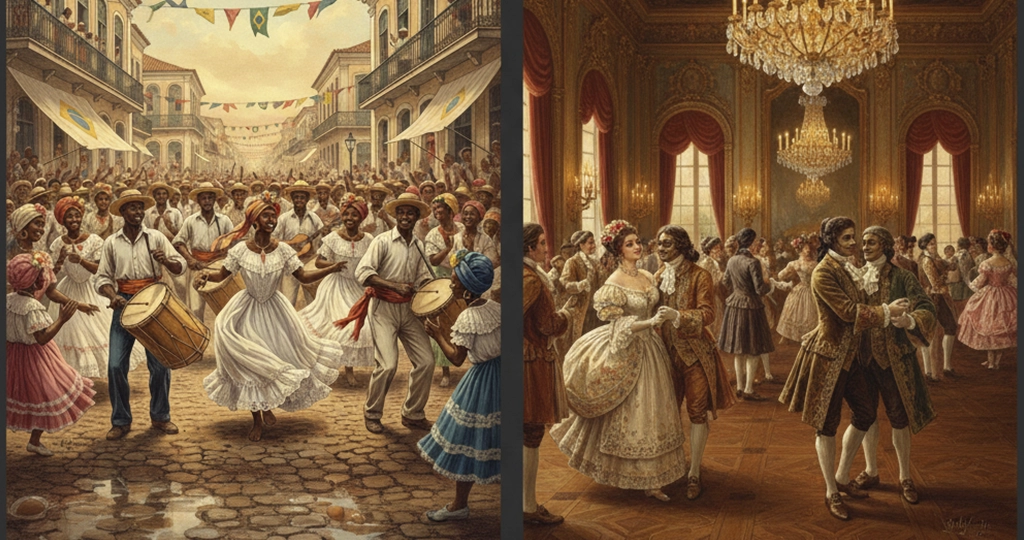
While the elite celebrated in their salons, the people—especially the liberated Afro-Brazilian population—created their own ways to celebrate in the streets. This gave rise to the Cordões and Ranchos.
Cordões: Spontaneous groups that marched with drums and singing, dancing through the crowds. They were the true precursors to samba schools.
Ranchos: These were more organized, featuring specific themes, coordinated costumes, and early versions of the “front commission.” They introduced a level of beauty and rhythm that began to shape the modern parade.
The Birth of the Samba School: “Deixa Falar” and Estácio
The major turning point occurred in the early 20th century in the Estácio neighborhood. In 1928, the group Deixa Falar was founded—the very first “Samba School.”
They innovated by focusing on a unique rhythm, Samba, to accompany their processions. The name “Samba School” was coined because the group met near a local teacher’s college (known as a “Normal School”), and the idea of “schooling” people in the art of samba stuck.
Consolidation and the Sambadrome

The popularity of these parades exploded. In 1932, the first official competition took place at Praça Onze. As the decades passed, the grandeur grew, moving locations several times to accommodate larger crowds.
Finally, in 1984, the Marquês de Sapucaí Sambadrome was inaugurated. Designed by Oscar Niemeyer, it provided a permanent stage for the parades, turning Rio’s Carnival into a global spectacle and a showcase of Brazilian culture to the world.
Today, the parades are a celebration of art, music, and history—a living legacy that continues to evolve and enchant the world every year.